All Newsletters
[Newsletter No.34] New Habitat of the Rare Fish Luciogobius pallidus Confirmed on Saryangdo Island
CBD-CHM Newsletter Vol. 34
New Habitat of the Rare Fish Luciogobius pallidus Confirmed on Saryangdo Island
The Honam National Institute of Biological Resources (HNIBR) of the Ministry of Climate, Energy and Environment confirmed, on October 22, a new habitat of the world's rarest fish Luciogobius pallidus on Saryangdo Island in Tongyeong, Gyeongsangnam-do. The discovery was made during a field survey using environmental DNA (eDNA)1) collected from island and coastal regions.
This discovery follows the first detection of genetic traces from the genus Luciogobius in an eDNA analysis conducted in May this year at the brackish water zone where seawater and freshwater meet on Saryangdo Island in Tongyeong. Based on this initial result, HNIBR conducted a follow-up field survey in October, during which an actual specimen was collected. Morphological and genetic analyses confirmed the specimen as Luciogobius pallidus.
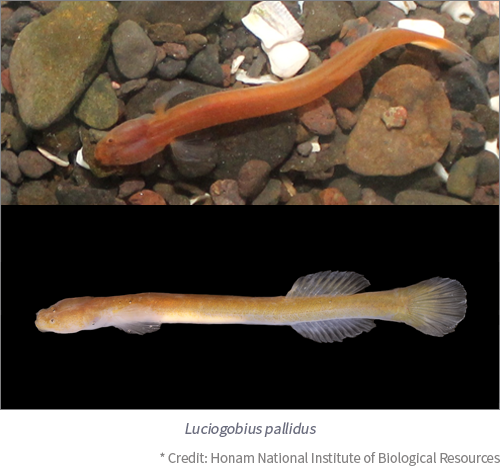
Luciogobius pallidus is an extremely rare of Gobiidae that inhabits sandy and gravelly intertidal zones of limited coastal regions including southern Kyushu in Japan and parts of Korea's southern coast. It measures approximately 4-5 cm in length and has a pale reddish body with translucent skin and fine red speckles.
Its tiny eyes are buried under the skin, and its slender, elongated shape allows it to move through narrow crevices. During the day, it hides under rocks or between shells and becomes active at night to feed on small benthic organisms. In Korea, the species has rarely been reported only from Jeju Island and Geojedo Island, and the specimens found on Saryangdo Island was the third confirmed record.
Sarayangdo is considered one of the representative southern island in Korea, known for the well-preserved biodiversity of its brackish water that support diverse fish species as well as Clithon retropictum (Endangered Wildlife Class II). The confirmation of both species in the same habitat highlights Sarayando Island as a key biodiversity hotspot where various organisms coexist.
Based on the collected samples, HNIBR plans to conduct comparative genetic analyses and revalidation of eDNA markers to further clarify species distributions and ecological characteristics in the surrounding marine area of Saryangdo Island.
An HNIBR researcher stated, "Using eDNA to detect rare species is a powerful method that allows us to scientifically confirm the presence of organisms that are difficult to discover through traditional research method." and added, "The research case in Saryangdo demonstrates fruitful outcomes, bringing a new potential of research on biodiversity conservation in island and coastal ecosystems."
1)
Environmental DNA (eDNA) is a method that indirectly confirms the presence of organisms through the analysis of DNA collected from a variety of environmental samples such as water, soil, and air.