
All Newsletters
[Newsletter No.44] Return of the Otter: 27 Otters Now Live in the Han River
CBD-CHM Newsletter Vol. 44
Return of the Otter: 27 Otters Now Live in the Han River
The National Institute of Biological Resources (NIBR), under the Ministry of Climate, Energy and Environment, announced that genetic analysis of fecal samples collected from Eurasian otters (Class I Endangered Wildlife) in the Han River from January through April this year confirmed that 27 otters are currently living in the river.
This represents an increase of approximately 80% from the 15 otters identified in a 2022 survey conducted by the Seoul Metropolitan Government. The NIBR genetically analyzed 106 otter fecal samples collected at 27 locations1) between Gayang Bridge and Godeok Bridge along the Han River—13 along the main channel and 14 along tributaries—and identified 21 otters in the main channel and six in tributaries. By sex, 16 were female and 11 were male.
Notably, the latest survey also confirmed the presence of otter families along the Han River. All 27 otters individually identified through genetic analysis were related to one another as siblings or other relatives, and five otter families consisting of parents and offspring were also identified.
These families were found mainly in the eastern part of the Han River, including Seongnaecheon Stream and the area around Jamsil Bridge. The largest number of otters was identified in Seongnaecheon Stream, with five individuals, followed by four at Hangang Bridge and three each at Yangjaecheon Stream, Jamsil Bridge, and Jungnangcheon Stream.
Otter habitats along the Han River declined significantly due to concrete channel-straightening development projects carried out in the 1960s and 1970s, but have gradually expanded since the 2000s as riverside ecological spaces were created through projects to restore the Han River’s natural environment.
Following a sighting of an otter in the Tancheon area of the Han River in 2016, four otters were first confirmed in 2017. Their habitat range has since expanded along the main channel as far as the Gangseo area and along tributaries as far as Jungnangcheon Stream to the north and Anyangcheon Stream to the south.
The survey was conducted as part of the Wildlife Status Survey Project, which the NIBR has carried out since 2007, to analyze changes in urban otter populations and their genetic health and to establish systematic management measures.
Yu Ho, President of the National Institute of Biological Resources, said, “The continued increase in the Han River’s otter population is a positive sign that the river’s ecosystem is recovering.” She added, “We will continue our scientific surveys, research, conservation, and management efforts so that people and urban wildlife can coexist and thrive.”
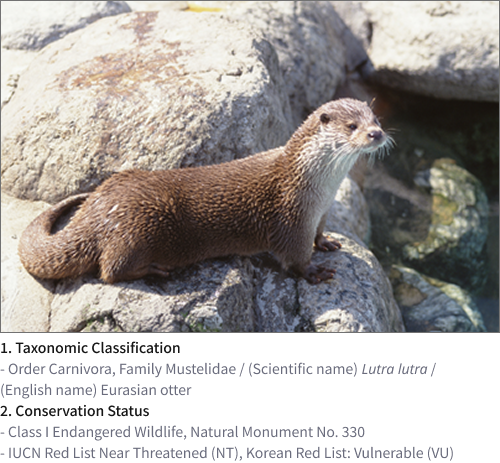
Otter Photographs and Description
1)
In 2022, the Seoul Metropolitan Government collected and analyzed 34 fecal samples from 17 locations (11 along the main channel and 6 along tributaries).