All Newsletters
[Newsletter No.43] Natural Compound from Freshwater Plant Actinostemma lobatum Found to Inhibit Crop-Pathogenic Fungi
CBD-CHM Newsletter Vol. 43
Natural Compound from Freshwater Plant Actinostemma lobatum Found to Inhibit Crop-Pathogenic Fungi
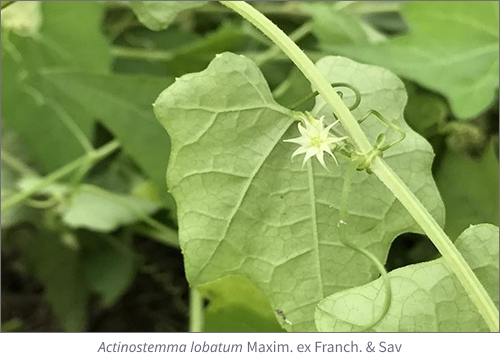
The Nakdonggang National Institute of Biological Resources (NNIBR), under the Ministry of Climate, Energy and Environment, announced that lobatoside C, a natural compound recently isolated from Actinostemma lobatum Maxim. ex Franch. & Sav., a freshwater plant native to Korea, was found to inhibit the growth of crop-pathogenic fungi, including Magnaporthe oryzae.
Crop diseases caused by pathogenic fungi reduce crop yields and quality, resulting in substantial economic losses each year.
Fungal disease control has relied largely on synthetic fungicides. However, concerns over risks to human health and the emergence of fungicide-resistant strains due to long-term use have increased interest in environmentally friendly disease control technologies.
Against this backdrop, NNIBR researchers have been searching since 2022 for antifungal compounds derived from freshwater plants that inhibit the growth of various crop-pathogenic fungi. As a result, they isolated and identified lobatoside C, a broad-spectrum antifungal compound, from an extract of Actinostemma lobatum.
The researchers’ analysis showed that lobatoside C exhibited broad-spectrum antifungal activity, inhibiting the growth of various crop-pathogenic fungi, including Magnaporthe oryzae, Rhizoctonia solani, and Fusarium graminearum.
In particular, by investigating the mechanism of its antifungal activity against Magnaporthe oryzae, the researchers confirmed that lobatoside C inhibits conidial germination and the formation of appressoria1), which are required for the fungus to invade plant tissue.
Based on these findings, NNIBR filed a patent application2) on August 10 for the antifungal use of lobatoside C.
This study goes beyond previous research on the efficacy of extracts by clearly identifying the active compound responsible for the antifungal activity, thereby laying the groundwork for the development and commercialization of environmentally friendly fungicides.
“This study demonstrates the potential for useful natural compounds discovered from native biological resources to be applied as environmentally friendly disease control technologies that can help protect agricultural environments,” said Yoo-jin Jeong, Director of the Applied Technology Development Division at NNIBR. “We will continue to expand research on the sustainable utilization of biological resources based on natural products.”
1)
A structure formed by a pathogenic fungus to penetrate the epidermis of a host plant and invade its tissues
2)
Antifungal Composition against Plant-Pathogenic Fungi Using Lobatoside C (Application No. 10-2026-0148891)