All Newsletters
[Newsletter No.43] Living Fossil Hidden in the Rock Crevices of Dolsando Island… New Species of Primitive Insect, Pedetontus obliquefasciatus, Discovered
CBD-CHM Newsletter Vol. 43
Living Fossil Hidden in the Rock Crevices of Dolsando Island… New Species of Primitive Insect, Pedetontus obliquefasciatus, Discovered
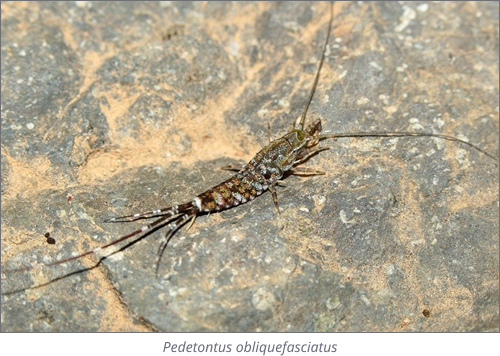
The Honam National Institute of Biological Resources (HNIBR), under the Ministry of Climate, Energy and Environment, announced that it recently identified Pedetontus obliquefasciatus, a new species of jumping bristletail, in a broadleaf forest on Dolsando Island in Yeosu, Jeollanam-do.
Jumping bristletails are known as “living fossils” because they retain primitive insect characteristics: they are wingless, continue to molt throughout their lives, and reproduce without direct mating.
These primarily nocturnal insects inhabit dark, humid environments such as forest leaf litter, tree bark, and lichens, and feed on lichens and mosses.
The new species, Pedetontus obliquefasciatus, was identified as part of HNIBR’s “Discovery of Native Species in Island and Coastal Areas (Insects)” project. A research team led by Professor So-ra Kim of Jeonbuk National University, which conducted the research project, carried out a taxonomic study of jumping bristletail specimens collected around Geumosan Mountain on Dolsando Island in September 2025, confirming it as the 13th new jumping bristletail species recorded on the Korean Peninsula.
More than 500 species of jumping bristletails have been recorded worldwide. This discovery marks the first addition of a new jumping bristletail species on the Korean Peninsula in 25 years, after 12 species had been documented by 2001.
Through taxonomic research on jumping bristletails collected on Dolsando Island, Professor Kim’s team distinguished the new species from previously known species of the genus Pedetontus based on morphological characteristics, including its diagonal white bands and body size, as well as differences in DNA sequences.
Reflecting its distinctive morphological feature, the research team named the species Pedetontus obliquefasciatus by combining the Latin words obliquus, meaning “diagonal,” and fasciatus, meaning “banded.”
The findings are scheduled to be published later this month in Zootaxa, an international scientific journal in the field of zoology.
“Building on the discovery of this new species and other new and previously unrecorded insect species, we will continue to conduct biodiversity research in island areas,” said Jae-seok Lee, Senior Researcher at HNIBR. “We will also take the lead in securing national sovereignty over its biological resources by actively utilizing advanced genetic analysis technologies in addition to morphological analysis.”